
Description
Glow Peptide Research Guide
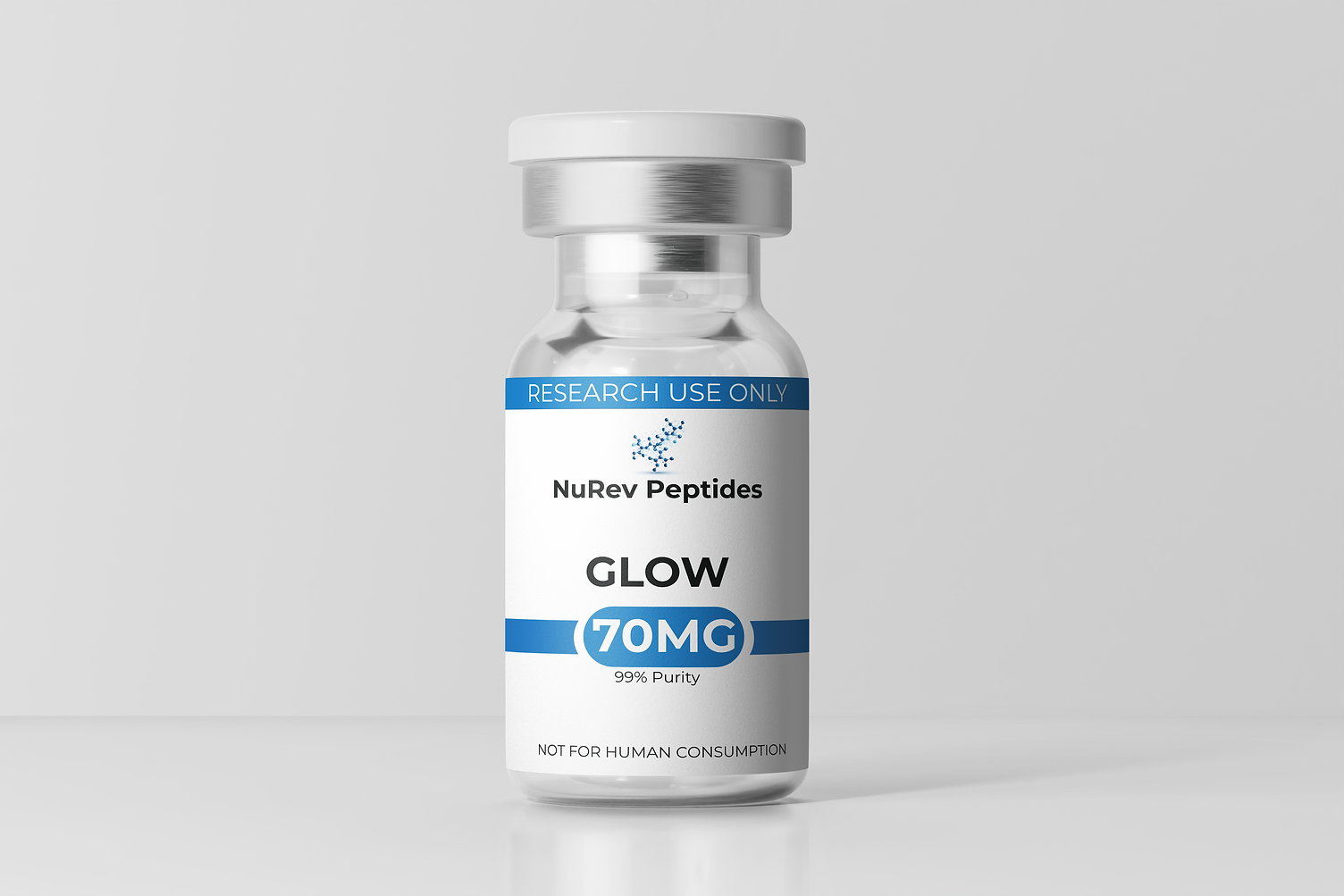
The Glow Peptide supplied by NuRev Peptides is a multi-component research compound designed for scientific investigations into tissue regeneration, cellular repair, and metabolic pathways. Multi-peptide formulations like this blend provide researchers with a way to examine synergistic effects across several well-studied bioactive peptides. Age-related declines in natural peptide levels make Glow Peptide especially relevant for studies involving tissue health, inflammatory responses, and repair mechanisms.
High-quality sourcing is essential; research peptides should always be obtained from reliable suppliers rather than unregulated compounding sources to ensure purity, consistency, and verified analytical data.
Molecular Structure of Glow Peptide (70mg Total)
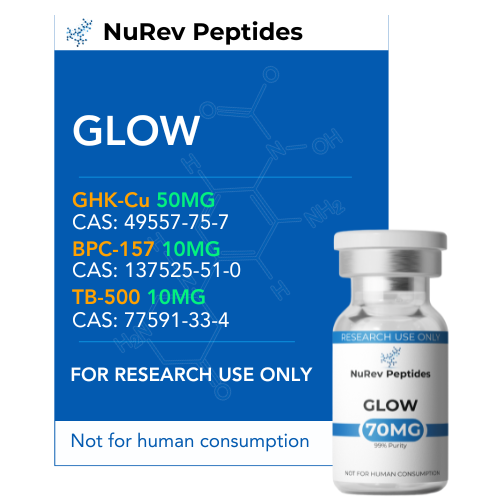
Glow Peptide consists of three primary research compounds:
| Component | Amount | Classification | Origin |
|---|---|---|---|
| BPC-157 | 10mg | Pentadecapeptide | Body-protection compound derivative |
| TB-500 | 10mg | Protein fragment | Thymosin Beta-4 partial sequence |
| GHK-Cu | 50mg | Copper-binding peptide | Naturally occurring copper complex |
BPC-157
- 15-amino-acid peptide derived from a gastric body-protection compound
- Approx. molecular weight: 1419 Da
- Studied for roles in angiogenesis, fibroblast migration, collagen support, and cytokine reduction (TNF-α, IL-6)
TB-500
- 17-amino-acid sequence from the active region of Thymosin Beta-4
- Approx. molecular weight: 4963 Da
- Examined for effects on actin regulation, cell migration, fibrosis reduction, immune-cell support, and tissue remodeling
GHK-Cu
- Tripeptide Gly-His-Lys with strong copper-binding affinity
- Natural copper complex found in plasma, saliva, and tissues
- Molecular weight: 340–400 Da depending on copper state
- Investigated for effects on collagen I/III synthesis, elastin production, GAG formation, antioxidant activity, and immune-cell attraction
Because GHK-Cu’s copper-binding state may change, the total molecular weight of the Glow formula varies.
Storage: Lyophilized form should be stored at 2–8°C; reconstituted solutions remain stable for up to 30 days refrigerated.
Combined Research Value of Glow Peptide
Glow Peptide allows researchers to explore:
- Tissue repair mechanisms
- Regenerative signaling pathways
- Wound-healing responses
- Collagen and elastin remodeling
- Anti-inflammatory actions
- Cellular migration and structural repair
- Stem-cell interactions
- Endothelial function
- Post-injury remodeling responses
This combination offers a comprehensive model for studying the biological processes involved in skin regeneration, muscular healing, and tissue remodeling.
Research & Laboratory Findings
GHK-Cu Highlights
- Enhances collagen and elastin synthesis
- Supports wound healing in lab models
- Studied for skin-firmness parameters
- Investigated for hair-follicle regeneration
BPC-157 Findings
- Accelerates tendon, ligament, and gastrointestinal-tissue repair in animal models
- Reduces inflammation and supports musculoskeletal recovery
TB-500 Findings
- Promotes repair-cell migration
- Reduces scar-tissue development in tissue-injury models
- Upregulates actin and supports structural repair processes
Glow Peptide Studies
Some controlled studies have evaluated Glow Peptide–like combinations, particularly in tissue-repair and wound-healing research. Evidence remains preclinical, and all components are classified strictly for laboratory research.
Storage & Safety Protocols
Storage
- Lyophilized: 2–8°C, protected from moisture and light
- Reconstituted: Stable up to 30 days refrigerated, longer at –20°C
- Allow vial to reach room temperature before opening
Administration & Concentration Guidelines
For research use, Glow Peptide components are provided in lyophilized form.
Preparation
- Reconstitute with sterile bacteriostatic water or saline
- Use aseptic technique, sterile gloves, calibrated pipettes, and microbalances
- Document all concentration and dilution steps
Experimental Application
- In vitro: Add directly to cell cultures to observe effects on collagen synthesis, wound-healing pathways, or cell migration
- In vivo (animal models): Typically administered subcutaneously or intramuscularly depending on research design
Disclaimer: The products mentioned are not intended for human or animal consumption. Research chemicals are intended solely for laboratory experimentation and/or in-vitro testing. Bodily introduction of any sort is strictly prohibited by law. All purchases are limited to licensed researchers and/or qualified professionals. All information shared in this article is for educational purposes only.
Reviews
There are no reviews yet.